Journal
Why Oodi is Hailed as the World’s Most Beautiful Library
Oodi, designed by ALA Architects at the heart of Helsinki, is less a library with extras than a gentle manifesto for how public space can make everyday creativity and learning feel completely ordinary.
Helsinki’s Oodi Central Library is often held up as one of the most beautiful libraries in the world, not because it’s a flawless object, but because it quietly rewrites what a public building can offer its citizens. Beauty here is less about Instagrammable angles and more about the way space, light and access come together to say: this place is genuinely for you.
View this post on Instagram
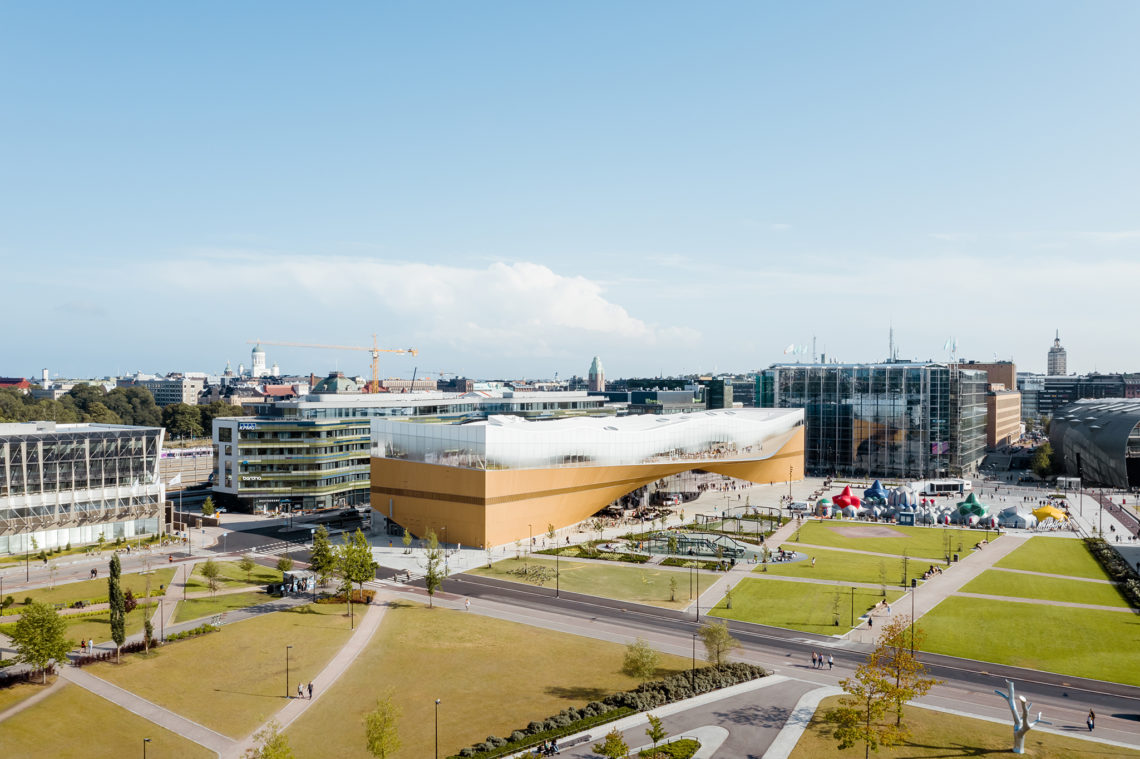
Designed by Finnish practice ALA Architects, Oodi sits right in the city centre, looking straight across the square to Parliament. The warm timber façade and generous glass make it read more as a welcoming pavilion than a stern civic monument, its long, flowing form hovering above a narrowed base like a ship resting lightly beside the park. It has presence, but it doesn’t loom over you.
 Photo: Tuomas Uusheimo/ALA Architects
Step inside and the ground floor has the easy energy of a busy café and station concourse combined, minus the stress. People chat, push prams, queue for loans, meet friends, scroll on their phones, refill their coffee. No one is shushed; you don’t feel as if you’re breaking a rule just by talking at a normal volume. ALA’s plan assumes that everyday life is allowed to spill into the library, not be scrubbed out at the door.
 Photo: Tuomas Uusheimo/ALA Architects
Upstairs, in the main book hall, the mood shifts without snapping into severity. The space opens out and quietens down. An undulating white ceiling stretches across the entire floor, dipping and rising like slow clouds, catching the daylight and spreading it in a soft, even wash. Combined with low shelves and seating arranged for lounging rather than perfect posture, it gives the strange sensation of reading under a gentle man‑made sky.
 Photo: Tuomas Uusheimo/ALA Architects
Just as important is what Oodi chooses to include beyond the stacks. ALA’s scheme tucks in recording studios, workshop rooms, gaming areas, screening spaces and bookable equipment for making and media work, treating sound, film, craft and digital production as part of the same ecosystem as reading and research. A teenager recording a track, a group cutting a short film, a retiree learning new software are all given the same quiet respect as someone deep in a novel.
 Photo: Tuomas Uusheimo/ALA Architects
Walk through the building and you keep catching small, ordinary scenes: children sprinting between play corners, students rehearsing in glass‑walled rooms, older couples sharing the newspaper by the windows. It feels less like a facility you visit for a narrow purpose and more like a slice of city life under one generous roof. When a city chooses to give its best site, its best light and its best furniture to this kind of shared, low‑threshold space, and architects like ALA respond by designing for comfort, messiness and dignity rather than display alone, the result is more than an attractive piece of architecture – it’s a way of living that many of us quietly envy.
Photo courtesy of Tuomas Uusheimo/ALA Architects