Journal
How Kengo Kuma Brought Bamboo Tradition to the Great (Bamboo) Wall House
In Chinese tradition, bamboo holds a place of honour among the "Four Gentlemen", a quartet of plants including plum blossom, orchid, and chrysanthemum that represent cultivated virtue and inner strength.
For generations, poets and scholars have seen in bamboo a mirror of human excellence it develops its characteristic segments while still underground, and even as it soars skyward, its stem remains hollow, a lesson in staying grounded despite success. This elegant plant has long inspired artists and writers, but today its also proving itself as a sophisticated building material in modern architecture. Japanese architect Kengo Kuma has been a leading voice in bamboo architecture. His project in Beijings Yanqing area showcases whats possible when this traditional material meets contemporary design vision, though Kuma himself insists on calling it the Great (Bamboo) Wall, not a house. The distinction matters. "Our first aim was to learn from the formality of the Great Wall," he explains. What captivated him wasnt the Wall as monument, but its refusal to stand apart from its landscape, the way it runs along the ridgeline in an almost endless conversation with the mountains themselves.
 For Kuma, this represented a quiet rebellion against architectures tendency toward isolation, its hunger to be noticed as a singular object. He wanted to apply this principle not to a fortification, but to the intimate act of dwelling.
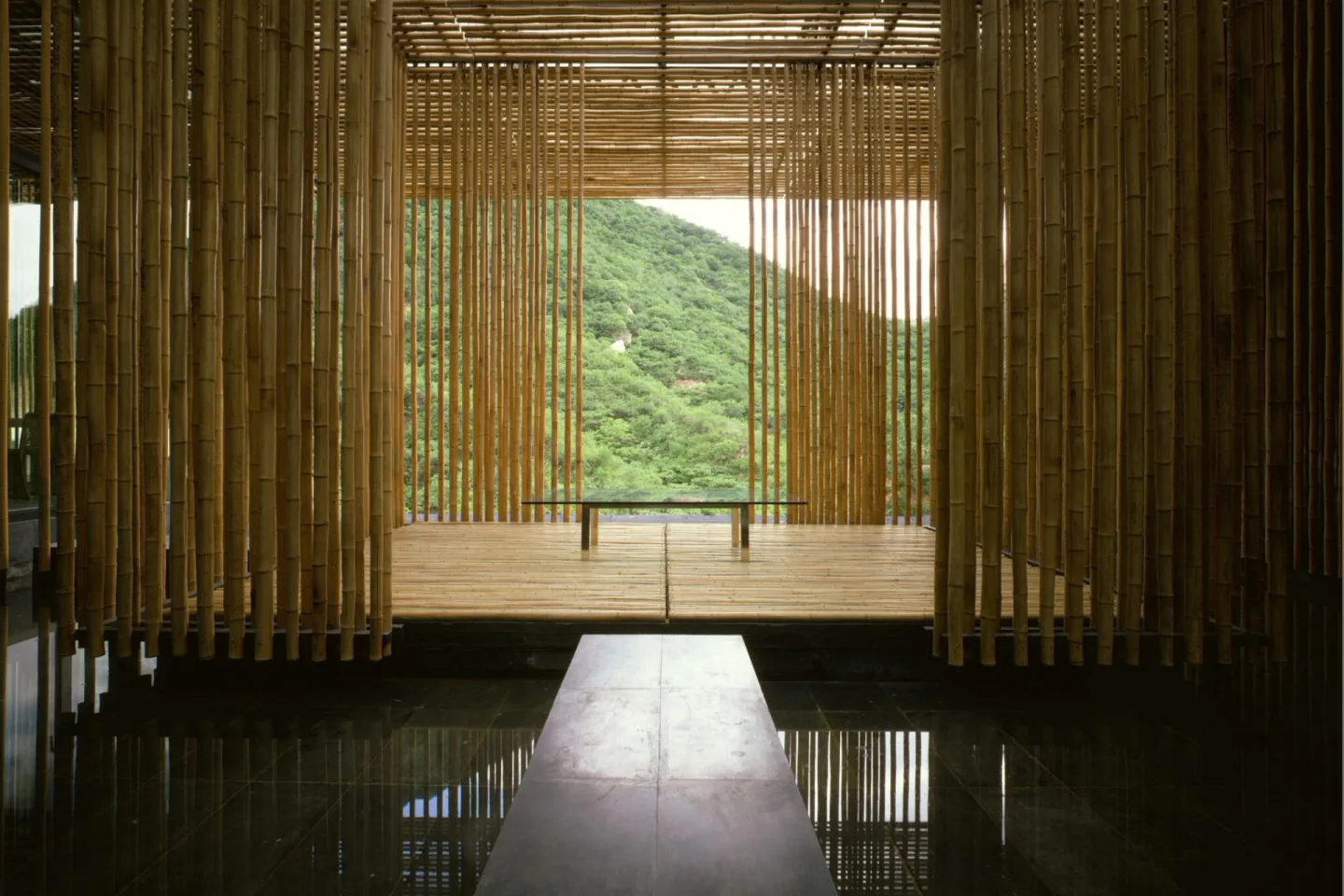
 Bamboo became his collaborator in this vision, a material that carries deep meaning across both Chinese and Japanese cultures. But Kuma understood bamboo as more than symbolism. He saw it as a system, recognizing how variations in density and diameter could create different relationships with space and light. Tightly woven bamboo cladding wraps around the building like a second skin, punctuated by sweeping glass panels. Sunlight filters through these bamboo screens, painting the interiors with constantly shifting patterns, a play of brightness and shade that evokes Zen tranquility.
 The architecture flows with the mountainside, hugging the slopes and blending into the landscape as if it had always been there. Its most striking feature is a tea pavilion that appears to float on water, bamboo walls on every side, offering views across the reflecting pool toward the Great Walls weathered watchtowers.
Photo courtesy of Kengo Kuma and Associates; Satoshi Asakawa