Art & Culture
Here's All the Fun from This Year's Cape Town Art Fair
Contemporary art from Africa is continuing unabatedly in seizing global attention.
https://www.instagram.com/p/B8lP-3spyjc/?utm_source=ig_web_copy_link
The pivotal anchor event to experience art from Africa and the world? The Investec Cape Town Art Fair [ICAF], housed in the city with a diverse cultural heritage, outstanding natural beauty, and a fabulous wine and food scene.
The 8th edition of ICAF recently wrapped to much success, revealing a host of artistic delights that reflect on the notion of African roots’. Over three days, it gathered artists, gallerists, curators, and collectors from across the continents and beyond to look at what it means to be from somewhere. A third of the galleries showed for the first time while 40% hail from outside Africa. We recap all of the fun and best discoveries from that week:
TODAY HERE, TOMORROW THE WORLD
For this section, curators selected a cross-section of emerging and underrepresented artists from Africa and the Diaspora to shine a light on the talents of tomorrow of the art world. Works followed an ongoing theme of transformation and experimentation that address social and political issues.
 Lights Will Guide You Home, Bonolo Kavula
Highlights included South African Bonolo Kavulas represented by Suburbia Contemporary Gallery, which uses a densely layered approach to printmaking and sculpture. Her work is subtle and beautiful, she is definitely one to watch.
 Untitiled, Ernesto Shikhani, 2003
Also showcased are works by Mozambican artist Ernesto Shikhani (1934-2010), who made a significant contribution to contemporary African art during a time when freedom and independence were visceral concepts to many living in Mozambique in the latter half of the 20th Century.
 François-Xavier Gbré, Eko Atlantic #1, Lagos, Nigeria, 2014
Côte dIvoires Galerie Cécile Fakhoury exhibited the work of French photographer Francois Xavier Gbre. Gbre explores and revisits history, using the language of architecture as a witness of memory and social change.
SOLO
The third iteration of the SOLO section welcomed mid-career artists to show a more comprehensive selection of work exploring space as the thematic focus. The highlight of this section has to be Sungi Mlengeya, showing with Afriart Gallery. Sungi Mlengeya is a Tanzanian-born artist and painter whose professional career only recently took off after she left the corporate world of banking. Currently represented by AfriArt Gallery, common themes in her work are cantered around black women. Sungi sheds light on their stories, their journeys, struggles, accomplishments, and relationships with their immediate societies, with her stories included in the narratives.
 Sungi Mlengeya, Constant+III, AfriArt Gallery
Her monochrome figures have the barest of highlights picking out their skin, while their clothes disappear into pure white backgrounds. They look both strong and vulnerable. It will be interesting to see where Mlengeya goes next with her art practice.
 Sungi Mlengeya, After Today, AfriArt Gallery
Salon Ninety-One presented a stunningly curated solo exhibition by Capetonian artist Kirsten Beets, who paints a place somewhere between the real and imagined. Her images show a sun-soaked, mythological notion of Eden, and the shifting relationship between people at leisure and the natural world all rendered in delicate detail.
 Season of Sun, 2019, Kirsten Beets
THE MAIN GALLERY
Everard Read Gallery represented artists from the United Kingdom, Europe, Nigeria, and the USA while retaining an impressive staple of Southern African artists. One of whom is Teresa Kutula Firmino. Her instantly recognisable collages of colourful boxed stage sets explore the trauma that her community has experienced and continues to suffer due to colonisation, civil wars, and present-day problems.
 Everard Read, Teresa Kutala Firmino, Blanced Rupture
Blessing Ngobeni moved to Johannesburg at a very young age, where he experienced many hardships, from living on the streets to serving time in prison, of which he describes as "the usual South African story." He has since then built an exceptional and unique career in the South African art industry. He uses his expressionist paintings not only to overtly critique the current status quo but to ask uncomfortable questions about the African experience of the world.
 Everard Read, Blessing Ngobeni, A Vehicle of Failed State
Visual artist Hugh Byrne lives and works in Cape Town, where he finds himself drawn to the citys lines, form, and structure. Currently focusing on paintings influenced by architecture and space, Hugh’s previous work includes film, sculpture, and photography. His subjects are lines and shapes of buildings, shadows, roads, and other geometric structures within the city, simplified, abstracted, and painted in vivid colours to create something new.
 Hugh Byrne, Nostalgia
Cape Town and Johannesburgs SMAC Gallery exhibited work from artist Frances Goodman, choose tools of practice come from the beauty industry, namely fake nails which she uses in a seductively sinuous snake-like way, in drawing attention to popular culture definitions of female identity, extremes of consumption, aspiration, obsession, desire, and anxiety. Israeli artist Galia Gluckman now living and working in Cape Town was also on show with SMAC. Gluckman worked as a fashion designer in London, UK, and New York City, before returning to fine arts; her works adjustment, and arrangement are both unique pieces that show her fashion design roots.
 Frances Goodman, Mermade, 2019
Elsewhere, October Gallery presented Alexis Peskines extraordinary and compelling works made from nails, gold leaf, wood, and coffee, using digital processes first and foremost. The gold leaf and flat nailheads add depth; however, it is only on close up inspection that you see the nail profile is not flat.
 October Gallery presented artist Alexis Peskine
Christopher Moller Gallery showed work from Dennis Osadebe and Tony Gum. Nigerian mixed-media artist Dennis Osadebe (born in 1991) is best known for his contemporary, vibrant post-pop style and use of flattened planes and bold colour. He refers to his style as a "neo-visual" it is modern, bright, expressive, and provocative. His characters wear a helmet as a form of protection, shielding them from the harmful effects of the outside environment, they also lend a sense of anonymity, disguising their identity.
 Works by Dennis Osadebe, Christopher Moller Gallery
 Tony Gum, Sweet Sabateur, 2019
Established in 2004, Cape Towns WORLDART is a contemporary art gallery that represents artists with a contemporary urban aesthetic that includes Cape Towns Norman OFlynn. He has a deep understanding and love of pop art, and his practice explores what it means in todays world. Meanwhile, Kilmany-Jo Liversage believes wholeheartedly in the power of colour. Her portraits intentionally blur the boundary between fine art and street art. At the Fair, we see her bold, colourful floral works.
 WORLDART, Norman OFlynn, Elephant in the room
What if the World Gallery [WITW] exhibited the work of South African Chris Soal. An award-winning artist who utilises everyday objects used and disposed of daily by millions of people around the world. His arrangement of toothpicks as a medium, engages the viewer on a physical level, encouraging a visceral reaction; some recoil while others have an overriding desire to touch them.
 Chris Soal, WITW, The Sharp Edge of Comfort
 A work by Chris Soal, WITW
WITW also showed South African artist and lacemaker Pierre Fouché, and Athi-Patra. South African artist Athi-Patra practice spans the mediums of costume, performance, video, and photography. His playful visual imagery draws from a diverse range of cultural references, while his hybrid figures appear to exist in a surreal world.
 WITW, Pierre Fouché
Dr. Esther Mahlangu, born 1935, is South Africas national treasure. Known as Mam Esther, she has taken the structured geometric kaleidoscope and vivid complexity of Ndebele art to the world. Mam Esther was taught the skills of mural painting with her fingers and feathers, by her mother in her rural village in Mpumalanga. Just as her mohters, own mother had taught her. Since her ascension to global notoriety in 1989, she has brought a touch of South Africa to the worlds attention.
 Dr Esther Mahlangu photographed by Clint-Strydom
 Works by Dr Esther Mahlangu
SOUTHERN PROJECT: SOUTHERN GUILD
Cape Towns Southern Guild makes its debut this year with a special project that introduced visitors to works that border art and design, exhibiting the work of South Africas leading designer-makers who push their work beyond every day to the realm of sculpture. Ceramicist Zizipho Poswa manipulates clay into the most incredible oversize vessels while Justine Mahoneys fantastical sculptures are deeply influenced by her childhood experiences growing up white in 1970s Apartheid Johannesburg.
 Justine-Mahoney, Venus, Southern Guild Gallery
The ubiquitous after parties are the finale to a fabulous week in Cape Town, with still much to explore with ongoing shows at local galleries, the Stellenbosch Triennale and ICAF Street Art Festival, and Design Indaba that stretch on through March and the rest of the year.
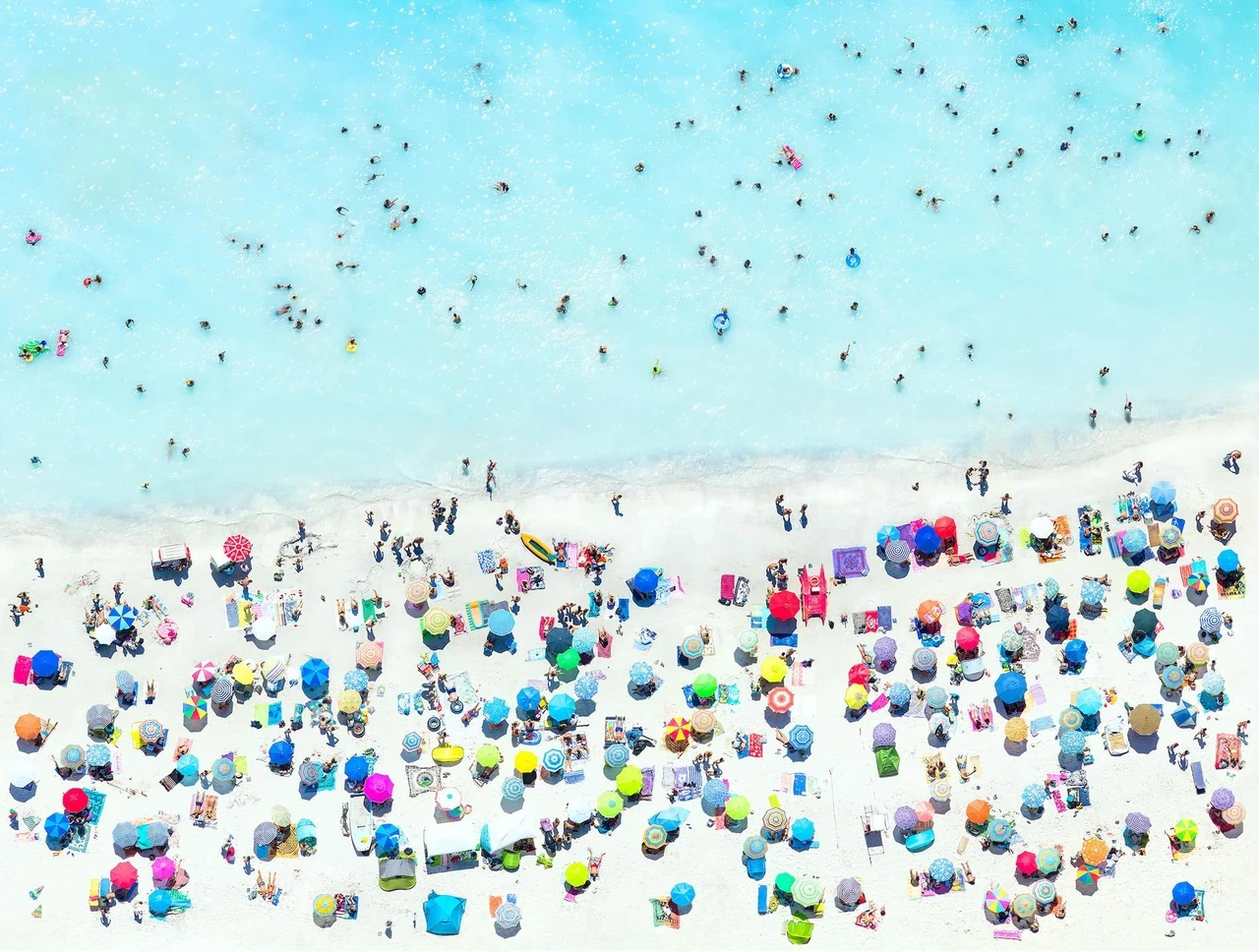
Scroll through the gallery below to see more of the highlight works and artists from the fair (all images courtesy of the artist, gallery and Cape Town Art Fair; cover photo Belgian artist Antoine Rose, known for his aerial shots that rescemble abstract minimalist paintings):